What Is Dwell Time in SEO? A Complete 2026 Guide
If you’ve been optimising your website for Google rankings, you’ve likely focused on keywords, backlinks, and page speed. But there’s one powerful metric quietly influencing your rankings that most marketers overlook — dwell time in SEO.
In this guide, we’ll cover exactly what dwell time in SEO means, how it differs from similar metrics, why it matters for your Google rankings in 2026, and six actionable ways to improve it.
What Is Dwell Time in SEO?
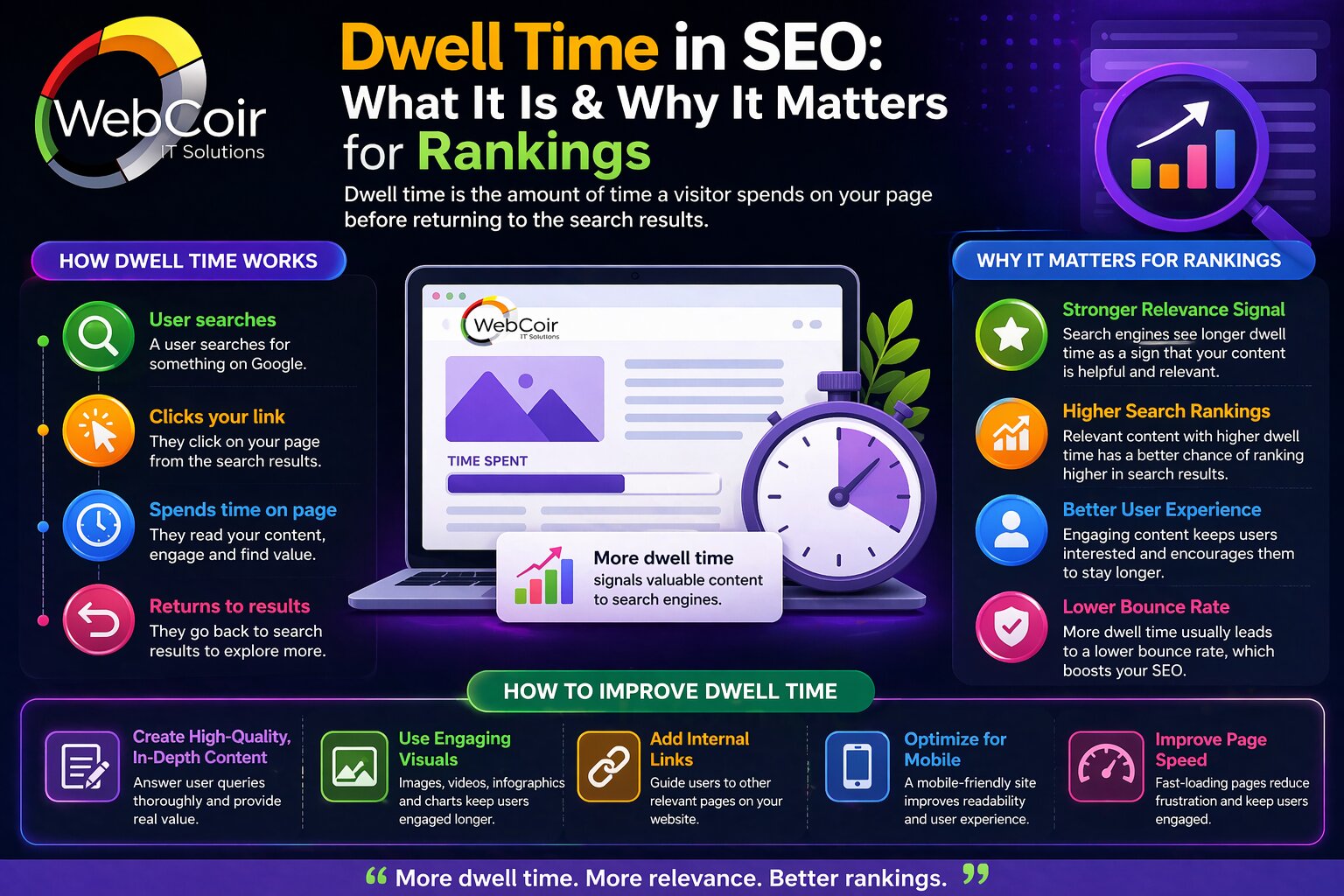
Dwell time in SEO refers to the amount of time a visitor spends on your webpage after clicking your link from the search engine results page (SERP) — and before returning back to those search results.
Think of it this way: a user searches for “what is dwell time in SEO”, clicks your result, reads your content for 4 minutes, and then goes back to Google. That 4 minutes is your dwell time.
A high dwell time tells Google that your content satisfied the user’s search intent. A low dwell time — say, 5–10 seconds — signals that the user didn’t find what they needed, which can hurt your rankings over time.
| Quick Definition — Dwell Time in SEO
Dwell time = Time from clicking a SERP result → to returning back to the search results page. Higher dwell time = positive user signal → Better rankings. Lower dwell time = negative engagement signal → Possible ranking drop. |
Dwell Time vs. Bounce Rate vs. Time on Page vs. Session Duration
This is where most people get confused. Dwell time in SEO is often mixed up with similar-sounding metrics. Here’s a clear breakdown optimized for AI Overviews and featured snippets:
| Metric | Definition | Source | Tracks Return to SERP? | Direct SEO Signal? |
| Dwell Time | Time spent on a page after clicking a SERP result, before going back to search results | Search Engine (Google/Bing) | Yes | Indirect (via engagement) |
| Bounce Rate | % of visitors who leave after viewing only one page, regardless of how they arrived | Google Analytics | No | Indirect |
| Time on Page | Total time spent on a specific page — includes all traffic sources, not just search | Google Analytics | No | Indirect |
| Session Duration | Total time a user spends across all pages in one visit to your website | Google Analytics | No | Indirect |
| CTR (Click-Through Rate) | % of users who click your result from the SERP out of total impressions | Google Search Console | No | Direct (confirmed signal) |
Why Dwell Time Matters for SEO in 2026
Google has never officially confirmed dwell time as a direct ranking factor. However, a 2024 leak of internal Google API documents revealed that Google tracks “long click” behaviour — how long users stay on a page before returning to search results. This strongly suggests dwell time influences rankings indirectly through user engagement signals.
Bing went further, explicitly stating in 2011 that dwell time is “a signal we watch” for determining page quality. In 2026, with AI-driven search algorithms becoming more sophisticated, user satisfaction signals like dwell time carry more weight than ever.
| 📊 Why Dwell Time Impacts Your Rankings
✅ Long dwell time → Content matches search intent → Google may reward with higher rankings ✅ High dwell time → Lower effective bounce rate → Better engagement metrics overall ❌ Short dwell time → Pogo-sticking behaviour → Google may demote your page ❌ Consistent low dwell time → Algorithm sees your page as low-quality for that query |
6 Proven Ways to Improve Dwell Time in SEO
Now that you understand what dwell time in SEO is and why it matters, here’s how to improve it:
1. Hook Readers Immediately with a Strong Introduction
Use the PPT Formula: Preview (tell readers what they’ll learn), Proof (show your credibility), Transition (guide them into the content). If users aren’t hooked in the first 3 lines, they leave — and that tanks your dwell time.
2. Publish Long-Form, In-Depth Content
It takes longer to read a 2,000-word guide than a 400-word article. Long-form content naturally increases dwell time — but only when it’s genuinely useful. Avoid fluff. Every paragraph should add value.
3. Embed Videos and Interactive Elements
A 2-minute embedded video adds at least 2 minutes to average dwell time for users who watch it. Interactive tools, calculators, and quizzes keep users engaged far longer than static text alone.
4. Match Content Exactly to Search Intent
This is the most critical factor. If a user searches “what is dwell time in SEO” and lands on a page selling analytics tools, they leave instantly. Audit every page to ensure your content format (guide, list, video, definition) matches what the searcher actually expects.
5. Improve Page Speed and Mobile Experience
Even a 1-second page load delay causes users to leave before they’ve started reading. With over 60% of searches now happening on mobile, a non-mobile-optimised page is a guaranteed dwell time killer.
6. Add Strategic Internal Links
Internal links invite users to explore more of your site. When readers click to a second or third page, your total session duration increases — a related positive engagement signal for Google.
What Is a Good Dwell Time?
There is no universal “good” dwell time. It varies by content type and search intent. Here’s a general benchmark:
| Content Type | Typical Good Dwell Time | What It Signals |
| Long-form blog / guide | 3 – 6+ minutes | Deep engagement, high content relevance |
| Product page (ecommerce) | 1 – 3 minutes | User evaluating options before purchase |
| News article | 1 – 2 minutes | Quick information consumption |
| Definition / FAQ page | 30 sec – 1.5 min | User found answer quickly (can be fine) |
| Homepage | 45 sec – 2 min | Navigation and brand exploration |
Final Thoughts: Dwell Time Is a User Satisfaction Signal
Dwell time in SEO is ultimately a measure of one thing: did your content satisfy the person who clicked? Google’s entire business model depends on showing useful results. When users stay on your page, read your content, and don’t immediately bounce back to search — Google notices.
You can’t game dwell time with tricks. The only sustainable way to improve it is to create genuinely helpful, well-structured content that answers exactly what your audience is searching for. Do that consistently, and your rankings will follow.