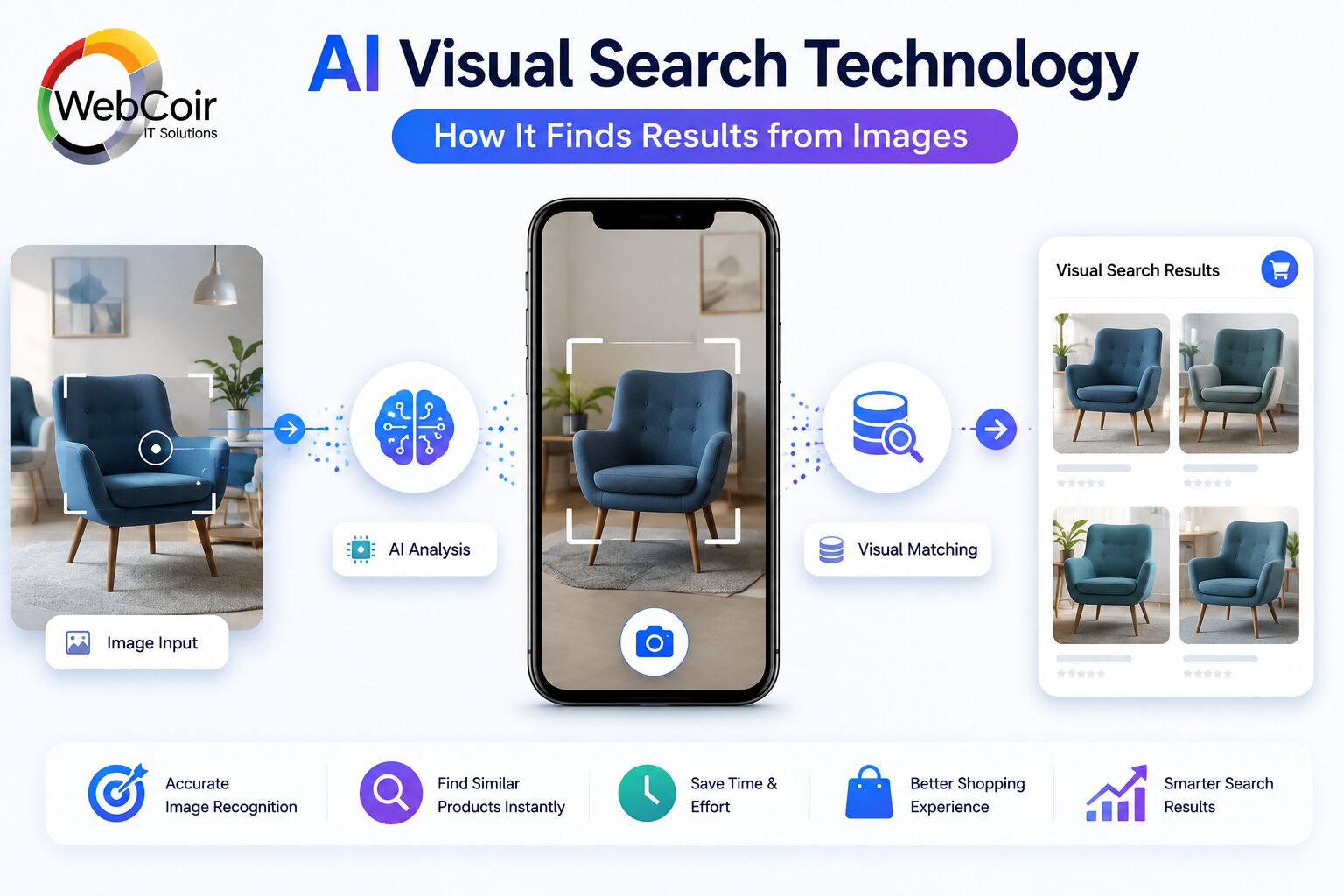
How Does AI Visual Search Work? A Complete Guide for Marketers in 2026
AI visual search is no longer a futuristic feature. In 2026, Google processes over 12 billion visual searches every month through Google Lens alone. Consumers in cities like Delhi, Mumbai, Bengaluru, and Hyderabad are pointing their phone cameras at products, storefronts, and packaging to find buying options instantly, without typing a single keyword. For digital marketers and ecommerce brands across India, understanding how does AI visual search work is now as essential as understanding how traditional search rankings function.
This guide explains the complete AI visual search pipeline, how it differs from traditional image search, why geo optimised local visibility matters, and what Indian brands must do to appear in visual search results in 2026.
What Is AI Visual Search and How Is It Different From Image Search?
Traditional image search starts with text. A user types a query like blue cotton kurta for men and Google returns image results based on metadata, alt text, and page content. The image itself is not analysed — the surrounding words are.
AI visual search reverses this completely. The user submits a photo or camera frame, and the system analyses the visual content itself — shapes, colours, textures, objects, and spatial relationships — to find matching results. The technology powering this is deep learning, specifically convolutional neural networks (CNNs) and vector embedding models that can understand what an image contains without any textual cue.
Understanding AI visual search vs traditional image search is critical because they require entirely different optimisation strategies. Text-heavy SEO alone will not make your products visible in a visual-first search environment.
How Does AI Visual Search Work: The Technical Pipeline
Step 1 — Image Ingestion and Preprocessing
When a user captures or uploads an image, the system first normalises it. This includes adjusting orientation, resolution, colour space, and removing noise. Consistent preprocessing ensures that the AI model receives standardised input regardless of the quality or format of the original image.
Step 2 — Feature Extraction via Convolutional Neural Networks
A deep learning model, typically a CNN architecture such as EfficientNet or a Vision Transformer (ViT), converts the image into a high-dimensional vector embedding. This embedding numerically represents the image’s visual characteristics including edges, textures, patterns, colour distributions, and object shapes. The model has been trained on billions of labelled images, giving it the ability to recognise objects, products, landmarks, and scenes with high accuracy.
Step 3 — Object Detection and Scene Segmentation
Models such as YOLO (You Only Look Once) or Mask R-CNN isolate individual objects within the frame. If a user photographs a kitchen, the system identifies the microwave, refrigerator, and countertop as separate, independently searchable entities. This allows visual search engines to return relevant results even when the user photographs a complex scene rather than a single product.
Step 4 — Vector Matching Against the Index
The image embedding is compared against a massive pre-computed index of known product and content embeddings using approximate nearest neighbour algorithms. Platforms like Google use their own ScaNN library for this retrieval step. The closest vector matches are returned in milliseconds, surfacing visually similar products, places, or content.
Step 5 — Multimodal Re-Ranking with Context
Raw visual matches are re-ranked using multimodal models like Google’s MUM (Multitask Unified Model), which layers in text signals, user location data, purchase intent signals, and knowledge graph connections. This is the step that transforms a simple visual similarity match into a contextually relevant, locally personalised answer — for example, showing a furniture item available from a store near the user’s location in Chennai or Pune.
Key Platforms Driving AI Visual Search in India in 2026
Google Lens dominates visual search behaviour in India, integrated into the default Android camera, the Google app, and Chrome. Indian users are among the highest adopters of Lens for product discovery, food identification, and local business lookups.
Pinterest Lens is growing rapidly in fashion, home decor, and lifestyle categories, with visual discovery driving strong shopping intent. Amazon’s in-app visual search tool is purpose-built for purchase journeys, directly connecting camera queries to product listings with pricing, ratings, and delivery information. Microsoft Bing Visual Search, powered by OpenAI’s GPT-4o vision capabilities, supports conversational visual queries through Copilot.
For Indian ecommerce brands and local businesses, Google Lens visibility in tier-one and tier-two cities is the highest-priority channel to optimise for in 2026.
Why Geo-Optimisation Matters for AI Visual Search in India
One of the most powerful aspects of how AI visual search works in 2026 is its integration with local intent signals. When a user in Bengaluru points their phone at a product in a local market, Google Lens does not just return generic product results. It surfaces locally available options, nearby stores, and Google Business Profile listings enriched with photos.
This makes geo-optimised image content directly tied to foot traffic and local sales. Businesses in India that upload high-quality, geotagged product and storefront images to their Google Business Profile, optimise image alt text with location-specific keywords, and implement LocalBusiness schema are significantly more likely to appear in Lens results for nearby searchers.
AI visual search for ecommerce SEO in India therefore demands a dual focus — national product catalogue optimisation and city-level local SEO image strategies for metros like Delhi, Mumbai, Kolkata, Hyderabad, and Pune.
How to Optimise Images for Google Lens and AI Visual Search
The practical answer to how to optimise images for Google Lens begins with image quality. High-resolution original photography with clean, well-lit backgrounds consistently outperforms stock images in visual search retrieval. AI models assign higher confidence to visually distinct, unambiguous product images.
Structured data is equally critical. Implementing Product, ImageObject, and LocalBusiness schema via Schema.org directly feeds the metadata layer that multimodal re-ranking systems use to contextualise visual matches. Pages with complete product schema are substantially more likely to appear in Google Lens shopping results than those without it.
Descriptive, specific alt text is another non-negotiable factor. Alt text such as hand-embroidered navy blue silk saree with gold border, Jaipur craftsmanship gives the AI both visual and textual signals to work with, improving retrieval accuracy. Images should be served in WebP or AVIF format for fast load speeds, and file names should be descriptive rather than default camera strings.
Finally, original visual content provides unique embeddings in the AI index. Brands that invest in custom product photography and distinctive visual assets avoid embedding collisions with shared stock imagery, giving their content a clearer, more retrievable identity in the visual search index.
Conclusion
Understanding how does AI visual search work in 2026 is no longer optional knowledge for marketers — it is a practical commercial requirement. The pipeline from CNN feature extraction to multimodal re-ranking is mature and deeply integrated into consumer behaviour across India. Brands that invest in original high-quality imagery, complete structured data, descriptive alt text, and geo-targeted local image optimisation will capture a growing share of visual discovery traffic that text-based SEO cannot reach. The shift from keyword-first to image-first search is already happening in every major Indian city, and the brands that prepare now will hold a lasting competitive advantage.
Frequently Asked Questions
How does AI visual search work differently from traditional search?
Traditional search analyses text keywords and surrounding page content to return results. AI visual search analyses the visual content of an image itself — using CNNs to extract features such as shapes, textures, colours, and objects — and matches them against a vector database of indexed visuals without requiring any text input from the user.
What is the difference between AI visual search and traditional image search?
Image search starts with a text query and returns images. AI visual search starts with an image and returns contextually relevant products, places, or information. The underlying AI pipeline, involving deep learning, vector matching, and multimodal re-ranking, is fundamentally different from text-based image retrieval.
How can I optimise images for Google Lens in India?
To optimise images for Google Lens, use high-resolution original photography, implement Product and ImageObject schema markup, write specific descriptive alt text including product attributes and location signals, serve images in WebP format, and maintain a complete and photo-rich Google Business Profile for local searches in Indian cities.
How is AI visual search useful for ecommerce SEO in India?
AI visual search for ecommerce SEO in India enables product discovery without keywords, which is especially powerful for fashion, home goods, and food categories. Brands with well-structured product catalogues, original imagery, and local schema markup are surfaced directly in Google Lens shopping results when users photograph similar products.
Which platforms support AI visual search in India in 2026?
The primary platforms are Google Lens, Amazon Visual Search, Pinterest Lens, and Microsoft Bing Visual Search. Google Lens is the dominant platform for Indian users given its deep integration with Android devices and the Google app, making it the most important channel for brands to optimise for.