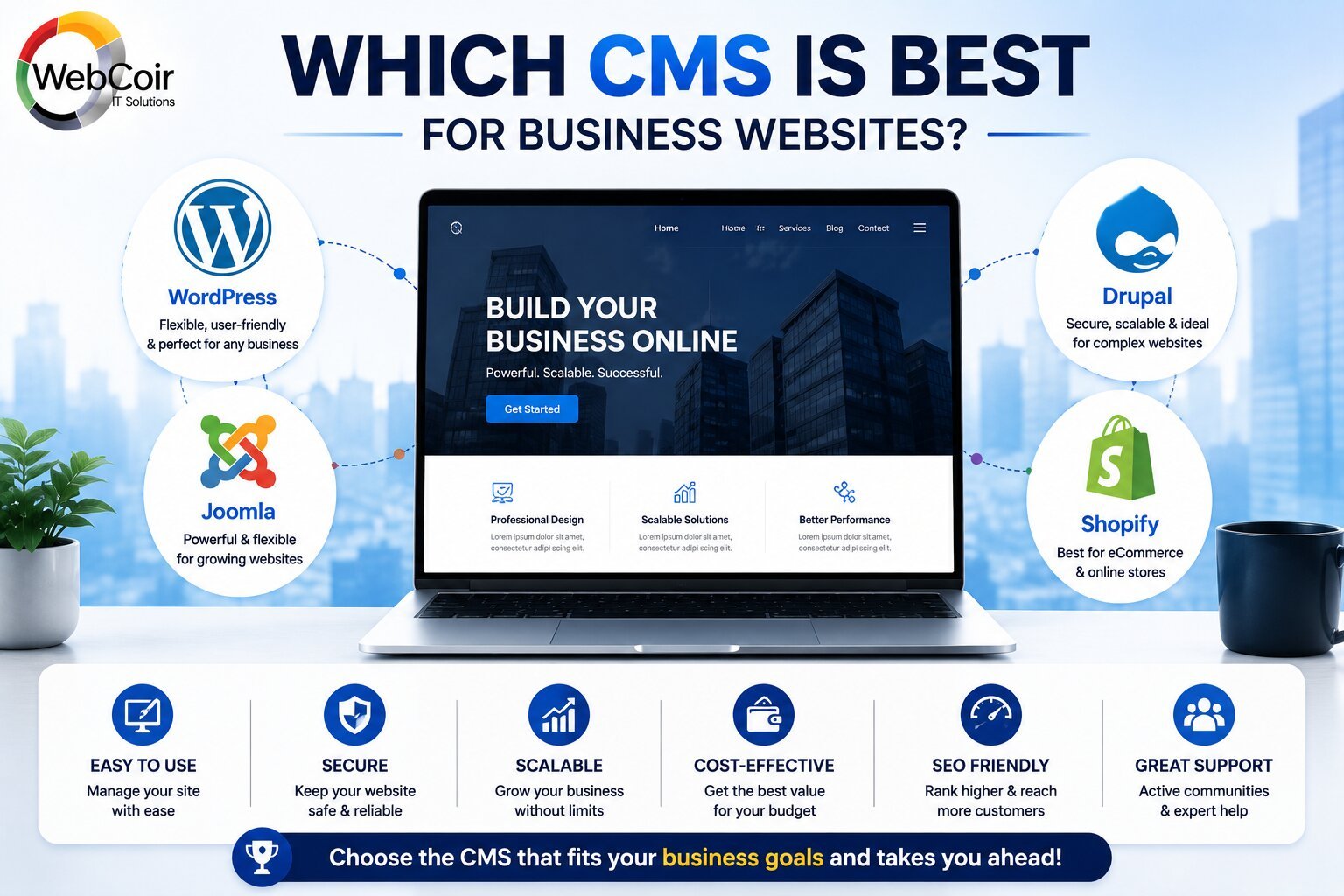
Which CMS Is Best for Business Websites?
WordPress is the best CMS for most business websites in 2026, thanks to its flexibility, plugin ecosystem, and SEO-friendliness. Webflow and HubSpot CMS provide advanced scalability for larger enterprises, while Shopify remains the most popular ecommerce platform.
Approximately 40% of all websites worldwide are powered by WordPress, and its popularity is largely due to three factors: cost-effectiveness, customization, and community support. Businesses can create anything from simple portfolio sites to complex multi-vendor marketplaces and multi-vendor marketplaces with thousands of themes and plugins (such as Yoast SEO, WooCommerce, and Elementor). Hosting can also be customized to your budget – from shared hosting to enterprise-grade managed WordPress hosting – since it’s open-source.
There is no one-size-fits-all CMS – it depends on your business size, technical capabilities, and growth plans. Businesses eventually outgrow off-the-shelf themes and need a CMS that’s custom-built for their workflows, integrations, and performance needs. Working with a dedicated CMS website development company makes a huge difference here. As a CMS website development company in India, Webcoir IT Solutions customizes CMS platforms to meet specific business needs rather than relying solely on generic templates including WordPress, Shopify, and headless CMSs. It is often more reliable to partner with specialized development teams to build a scalable, secure, and brand-specific CMS than to build it yourself.
Beyond WordPress, here’s how the other major CMS options compare:
Webflow is ideal for design-heavy business websites where visual control matters. It offers a no-code visual builder with clean, hand-coded-quality output, making it popular with marketing teams and agencies. The tradeoff is a steeper learning curve for complex functionality and higher pricing at scale.
HubSpot CMS works best for businesses already using HubSpot’s marketing and CRM tools. It integrates SEO, analytics, and lead-tracking directly into the CMS, which is valuable for B2B companies focused on inbound marketing — though it’s less flexible and more expensive than WordPress.
Shopify is purpose-built for ecommerce. If your business website’s primary function is selling products online, Shopify’s checkout, inventory, and payment integrations are hard to beat, even though it’s less suited to content-heavy or blog-driven sites.
Drupal suits large enterprises and government-level websites needing robust security and complex data structures, but it requires more technical expertise to manage compared to WordPress.
Wix is a good fit for small businesses or solopreneurs wanting a fast, simple setup with minimal technical know-how, though it offers less long-term scalability.
Quick Recommendation Based on Business Type
- Small business / startup: WordPress or Wix
- Ecommerce store: Shopify or WordPress (WooCommerce)
- B2B / marketing-driven company: HubSpot CMS
- Design agency / portfolio-heavy site: Webflow
- Enterprise / large-scale organization: Drupal or a custom-built CMS
Final Answer
For most businesses, WordPress remains the best overall CMS due to its balance of cost, flexibility, and scalability. However, if your website has unique functional requirements — custom integrations, advanced performance needs, or a need for ongoing technical support — working with a specialized CMS development company can help you avoid common pitfalls and build a system that scales with your business rather than against it.