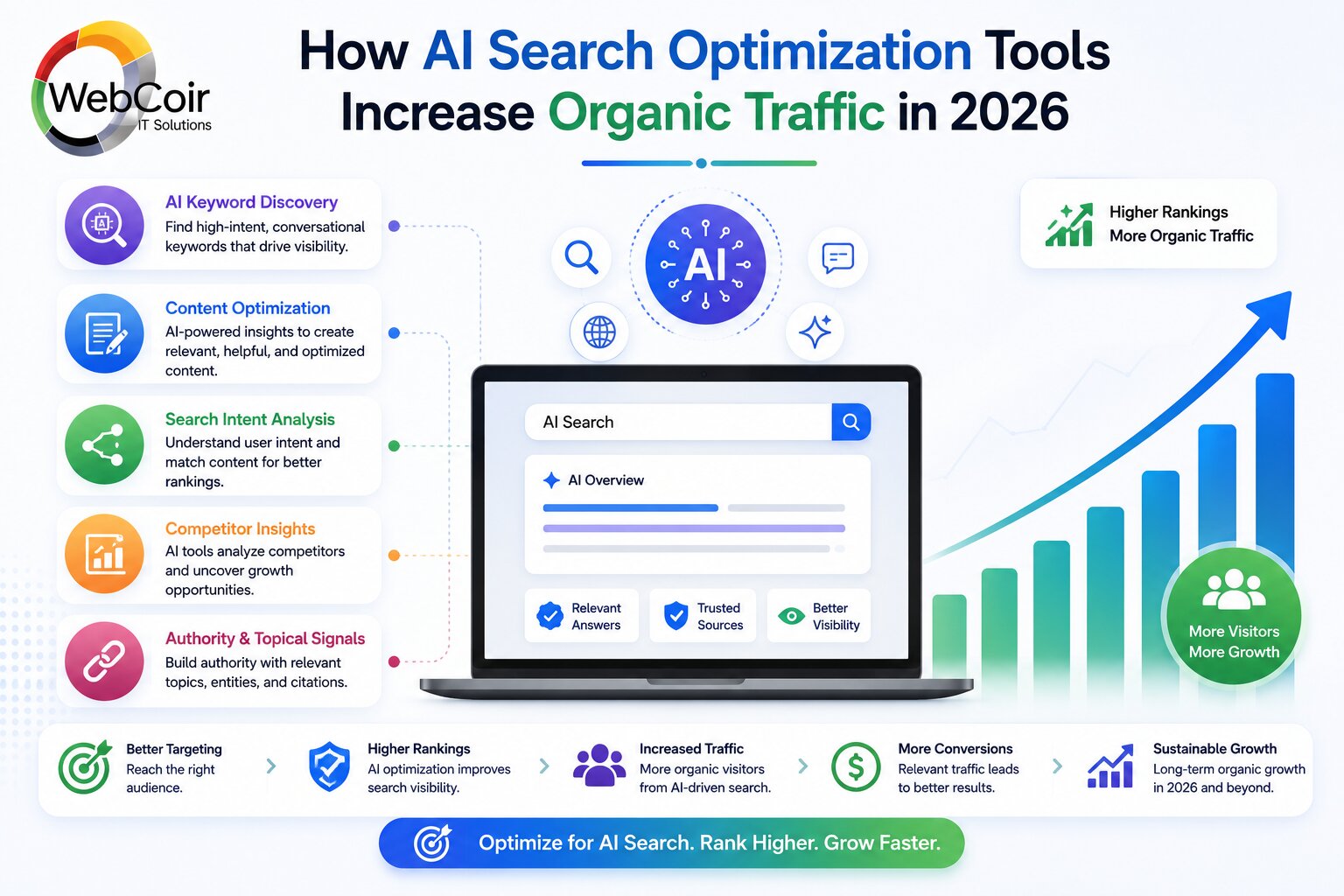
How AI Search Optimization Tools Increase Organic Traffic in 2026
Organic traffic growth has become harder to achieve through traditional SEO alone. Google AI Overviews now appear on roughly 30 percent of all search queries. Bing Copilot and Perplexity pull meaningful traffic away from standard blue links. For businesses across India from startups in Bengaluru to ecommerce brands in Delhi and service companies in Mumbai the question is not whether to adopt AI search optimization tools, but how these tools actually translate into more visitors, better rankings, and measurable revenue.
The honest answer is that AI tools do not simply write more articles faster. Their real value lies in reshaping how keyword research, content structuring, technical auditing, and visibility tracking are done aligning every SEO decision with how both traditional search engines and large language models now surface information.
1. AI-Powered Keyword Intelligence That Goes Beyond Search Volume
Traditional keyword research relied on three metrics: search volume, keyword difficulty, and cost per click. AI search optimization tools have made this approach obsolete for competitive markets. Platforms like Semrush Copilot, Ahrefs AI features, and Frase now cluster semantically related queries into intent groups, allowing businesses to build a single content asset that satisfies an entire topic rather than chasing individual keywords.
For Indian websites, this is particularly valuable. Search behaviour across cities like Hyderabad, Pune, Chennai, and Kolkata reflects regional language patterns, conversational phrasing, and hyper-local intent that manual keyword research consistently misses. AI keyword research tools for Indian websites surface these patterns automatically, identifying long-tail opportunities in Hindi-English code-switching queries, location-specific service searches, and voice-driven conversational inputs that have grown significantly with smartphone adoption across tier-two cities.
The outcome is fewer pages that rank for broader query sets. This directly reduces content production costs while improving traffic per published page — a measurable advantage for businesses operating with lean digital marketing teams.
2. Content Optimization Structured for AI Overviews and Featured Snippets
Understanding how AI tools improve Google rankings in 2026 requires examining what happens after keyword selection. The structure of content itself determines whether a page appears in AI-generated answers or stays invisible in the results.
AI search optimization tools like Frase, Rankability, and Clearscope analyse top-ranking pages using NLP models and recommend specific paragraph structures, header hierarchies, and answer placements that match how Google extracts information for AI Overviews. The key principle is answer-ready formatting: providing a clear, direct response within the first two sentences of each section so that Google’s AI can extract and surface it without requiring full-page context.
Entity and schema optimization is equally critical. Tools identify named entities — people, places, products, concepts — that Google’s Knowledge Graph associates with a topic. Including these entities with proper schema markup increases the likelihood of appearing in knowledge panels and AI-generated summaries. For local Indian businesses, implementing LocalBusiness and Service schema alongside city-specific entity signals measurably improves visibility in geo-targeted search results across Delhi NCR, Mumbai, Bengaluru, and other priority markets.
3. Technical SEO Auditing Accelerated by Machine Learning
Organic traffic gains are not purely about content quality. Technical foundations determine whether search engines can crawl, render, and index pages efficiently. AI-enhanced technical SEO tools have transformed auditing speed and precision for Indian businesses managing large websites.
Platforms like Screaming Frog with AI integrations and Sitebulb use machine learning to prioritise crawl issues by estimated traffic impact rather than listing every problem with equal urgency. For an ecommerce site in India with thousands of product pages, this means fixing a Core Web Vitals issue that affects 40 percent of sessions before addressing a minor redirect chain on a low-traffic subcategory page.
AI-powered log file analysis identifies crawl budget waste patterns — such as Googlebot repeatedly hitting paginated URLs or parameter variations — that human analysts might take days to spot manually. Internal linking tools map link equity distribution across the site and recommend changes that channel PageRank toward priority landing pages, directly supporting ranking improvements for competitive commercial keywords in Indian markets.
4. LLM Visibility Tracking: The New Metric That Traditional Rank Trackers Cannot Measure
One of the most significant developments shaping how AI search optimization tools increase organic traffic in 2026 is the emergence of LLM visibility tracking. Tools like BlueprintIQ and Peec monitor how frequently a brand or piece of content is cited inside ChatGPT, Perplexity, and Google AI Overview responses when users ask relevant questions.
This matters for Indian businesses because an increasing share of user attention never reaches a traditional search result page. When a user in Noida asks Perplexity for the best chartered accounting firms in Delhi NCR, or a shopper in Ahmedabad asks Google’s AI Overview which home appliance brand has the best warranty support in India, the citations those tools provide directly influence purchase decisions — without a single click to a search results page.
Without LLM visibility tracking, teams optimise for traditional rankings while remaining blind to an entirely separate and growing distribution channel. The best AI SEO tools for organic traffic in India now integrate both traditional rank monitoring and LLM citation frequency into a unified reporting view.
5. Geo-Optimisation: Why Location-Specific AI SEO Matters for Indian Brands
A key dimension that generic global SEO advice consistently misses is how AI search optimization tools must be applied with geo-specific strategy for Indian markets. Search intent, query phrasing, and competitive density vary significantly between Mumbai and Bengaluru, between a metro like Delhi and a tier-two market like Jaipur or Indore.
AI tools enable geo-optimised content strategies by surfacing city-level keyword opportunities, identifying which local competitors dominate specific urban search markets, and recommending on-page and schema changes that improve local pack visibility. For service businesses targeting multiple Indian cities simultaneously, AI-assisted content briefs that incorporate location-specific entities, local landmarks, and city-level intent signals consistently outperform generic national SEO approaches.
Combining geo-targeted content with AI-driven technical auditing and LLM visibility tracking creates a full-funnel organic strategy that captures both traditional search traffic and the growing volume of AI-mediated discovery across India’s major urban markets.
Conclusion
How AI search optimization tools increase organic traffic is not a single-step answer. These tools improve every stage of the SEO workflow — from smarter keyword clustering and answer-ready content structuring to machine-learning-powered technical auditing and entirely new LLM visibility metrics. For Indian businesses competing across Delhi, Mumbai, Bengaluru, Hyderabad, and beyond, integrating these tools with a geo-specific strategy and maintaining human editorial quality is what separates sustainable traffic growth from temporary ranking gains.