Brand Funnel: Stages, Metrics and How to Optimize Your Brand Growth
Direct Answer
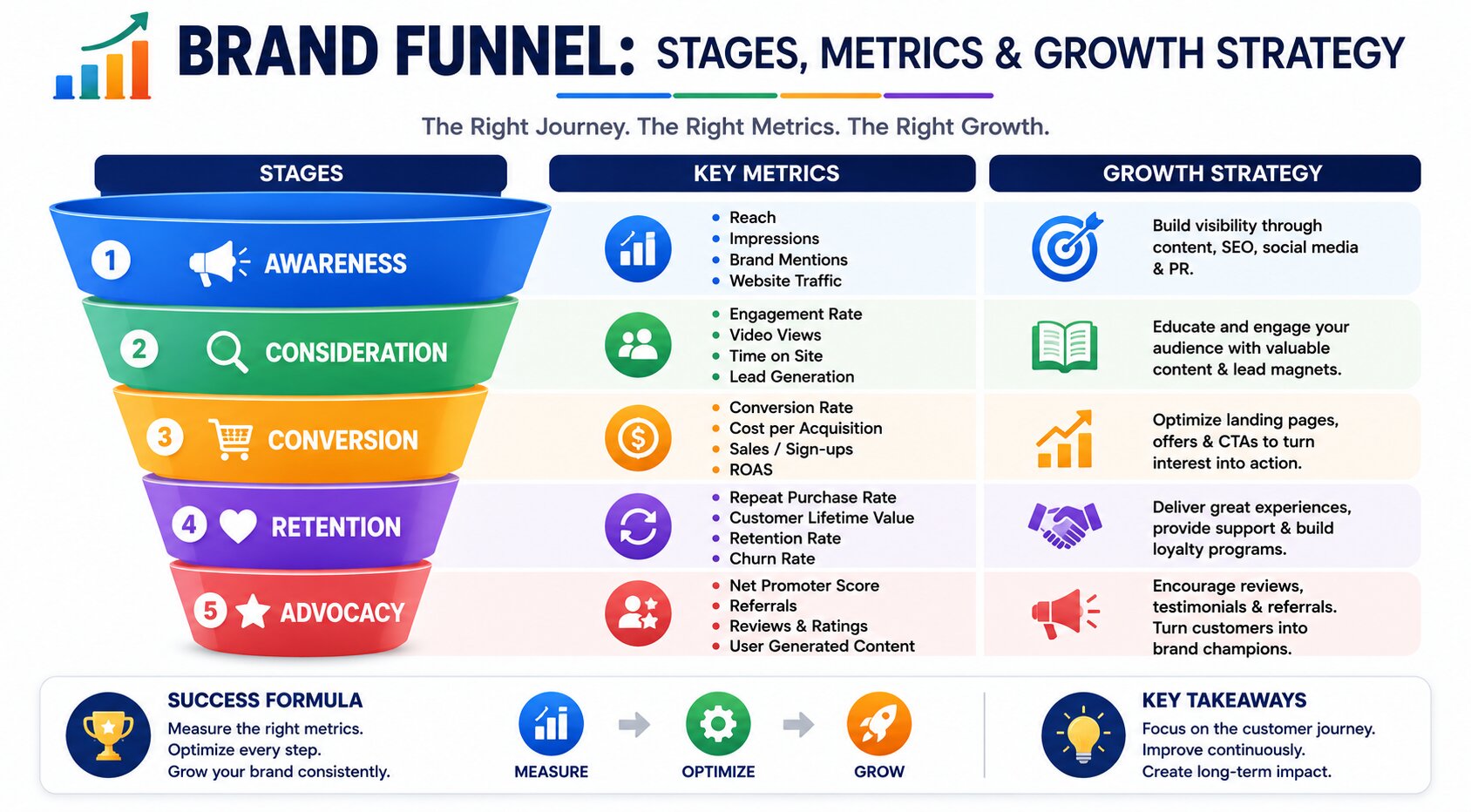
A brand funnel is a strategic framework that maps the journey a customer takes from first hearing about your brand to becoming a loyal advocate. It typically includes five stages: Awareness, Familiarity, Consideration, Purchase, and Loyalty. Brand funnel metrics measure how effectively your brand moves people through each of these stages.
Most businesses measure what they sell. The most successful businesses also measure how their brand is perceived at every stage before the sale. That is the purpose of a brand funnel. It gives you a data-driven view of brand health, reveals where customers are dropping off, and tells you exactly where to invest to grow faster.
This guide explains what a brand funnel is, breaks down its five key stages, identifies the brand funnel metrics that matter, and shows how to optimise each stage for maximum growth in 2026.
What Is a Brand Funnel?
A brand funnel is a model that visualises how a target audience progresses through distinct stages of awareness and engagement with your brand. Unlike a sales funnel, which focuses on transaction, a brand funnel measures perception, preference, and trust over time.
It answers questions that revenue metrics alone cannot: Do people know your brand exists? Do they understand what you stand for? When they are ready to buy, do they choose you over a competitor? A healthy brand awareness funnel means customers arrive at the purchase decision already predisposed to choose you, which lowers acquisition costs and increases lifetime value.
A brand funnel does not replace your sales funnel. It feeds it. A strong brand makes every stage of the sales process easier, faster, and cheaper.
The 5 Stages of a Brand Funnel
Stage 1: Awareness — Does Your Audience Know You Exist?
Awareness is the entry point of the brand awareness funnel. It measures the percentage of your target audience that has heard of your brand. Without awareness, nothing else in the funnel can function. At this stage, the goal is reach: getting your brand name in front of the right people through SEO content, social media, PR, and paid media.
Stage 2: Familiarity — Do They Know What You Do?
Familiarity goes beyond name recognition. It asks whether your audience understands your offer, your values, and why you are different. This stage is often where brands stall. High awareness with low familiarity means your messaging is not landing. Content marketing, thought leadership, and consistent brand storytelling are the primary tools here.
Stage 3: Consideration — Are You on Their Shortlist?
Consideration measures whether your brand is being actively evaluated when a buying decision is approaching. This is a critical customer journey stage because it is where brand equity becomes a commercial advantage. Brands with strong reputation scores, positive reviews, and visible authority win the consideration battle more often and at lower cost.
Stage 4: Purchase — Do They Choose You?
The purchase stage converts brand preference into revenue. At this point, brand funnel metrics overlap with traditional sales metrics: conversion rate, cost per acquisition, and close rate. A brand that has invested well in the earlier stages will consistently outperform competitors at this stage because trust has already been established.
Stage 5: Loyalty and Advocacy — Do They Come Back and Refer Others?
The bottom of the brand funnel is where the highest long-term value is created. Loyal customers cost less to retain, spend more per transaction, and generate new customers through word-of-mouth and organic referrals. Brand equity measurement at this stage looks at Net Promoter Score, repeat purchase rate, and customer lifetime value.
Key Brand Funnel Metrics to Track at Every Stage
Each stage of the brand funnel requires its own set of measurements. Tracking only revenue misses the signals that predict future growth or decline.
- Awareness Metrics: Unaided and aided brand recall, share of voice, branded search volume, social reach and impressions
- Familiarity Metrics: Content engagement rate, average time on page, email open rate, social media saves and shares
- Consideration Metrics: Branded keyword rankings, review volume and sentiment, direct traffic growth, comparison page visits
- Purchase Metrics: Conversion rate, cost per acquisition, revenue per customer, lead-to-close ratio
- Loyalty Metrics: Net Promoter Score, repeat purchase rate, customer lifetime value, referral rate
Reviewing these brand funnel metrics monthly gives you early warning signals. A drop in branded search volume, for example, often predicts a future decline in conversions weeks before it appears in revenue data.
How to Optimise Each Stage of Your Brand Funnel
Fix the awareness gap first. If fewer than 30 percent of your target audience recognises your brand, invest in high-reach content, PR, and social advertising before optimising lower stages.
Clarify your positioning at the familiarity stage. Audit your website, content, and social profiles. If a first-time visitor cannot understand your core offer in five seconds, your familiarity score will remain low.
Build reputation at the consideration stage. Actively generate and manage reviews, create comparison content, and publish case studies. This is where brand equity measurement tools and ORM services become essential.
Reduce friction at the purchase stage. Streamline your conversion path. Every unnecessary step between consideration and purchase loses customers who were already willing to buy.
Create loyalty programmes and referral systems. The most cost-effective brand growth comes from turning existing customers into advocates. Invest in post-purchase communication, loyalty rewards, and community building.
How Webcoir IT Solutions Strengthens Your Brand Funnel Through ORM
One of the most overlooked variables in brand funnel performance is reputation. A strong brand awareness funnel can be undermined entirely by negative reviews, inaccurate search results, or poor sentiment in the consideration stage. This is where expert ORM services become a strategic investment, not just a defensive measure.
Webcoir IT Solutions is a leading ORM services provider in India, helping businesses take control of how their brand appears at every stage of the funnel. From building positive review profiles that improve consideration-stage conversions to managing brand sentiment in search results and AI-generated recommendations, Webcoir IT Solutions aligns reputation management with your full brand funnel strategy.
For Indian businesses ready to build a brand funnel that converts at every stage and builds compounding equity over time, Webcoir IT Solutions delivers the strategy, tools, and execution to make it measurable and scalable.
Frequently Asked Questions
What is a brand funnel and why does it matter?
A brand funnel is a framework that maps the stages a customer moves through from first becoming aware of a brand to becoming a loyal advocate. It matters because it gives businesses a structured way to measure brand health, identify where customers are disengaging, and invest marketing resources at the stages that will have the greatest impact on long-term growth.
What are the most important brand funnel metrics to track?
The most important brand funnel metrics include branded search volume and unaided recall at the awareness stage, content engagement at the familiarity stage, review sentiment and branded keyword rankings at the consideration stage, conversion rate at the purchase stage, and Net Promoter Score and repeat purchase rate at the loyalty stage. Tracking all five stages gives a complete picture of brand performance.
How is a brand funnel different from a sales funnel?
A sales funnel focuses on moving a qualified lead through the steps of a transaction. A brand funnel measures perception and preference across a much broader audience, including people who are not yet ready to buy. A strong brand funnel feeds the sales funnel by ensuring that when prospects do become ready to purchase, your brand is already their preferred choice.
How does ORM help improve brand funnel performance?
ORM improves brand funnel performance primarily at the consideration and loyalty stages. Positive reviews, accurate search results, and strong sentiment signals increase the probability that prospects choose your brand over competitors when evaluating options. At the loyalty stage, proactive reputation management protects brand equity and reduces customer churn caused by unaddressed negative feedback.