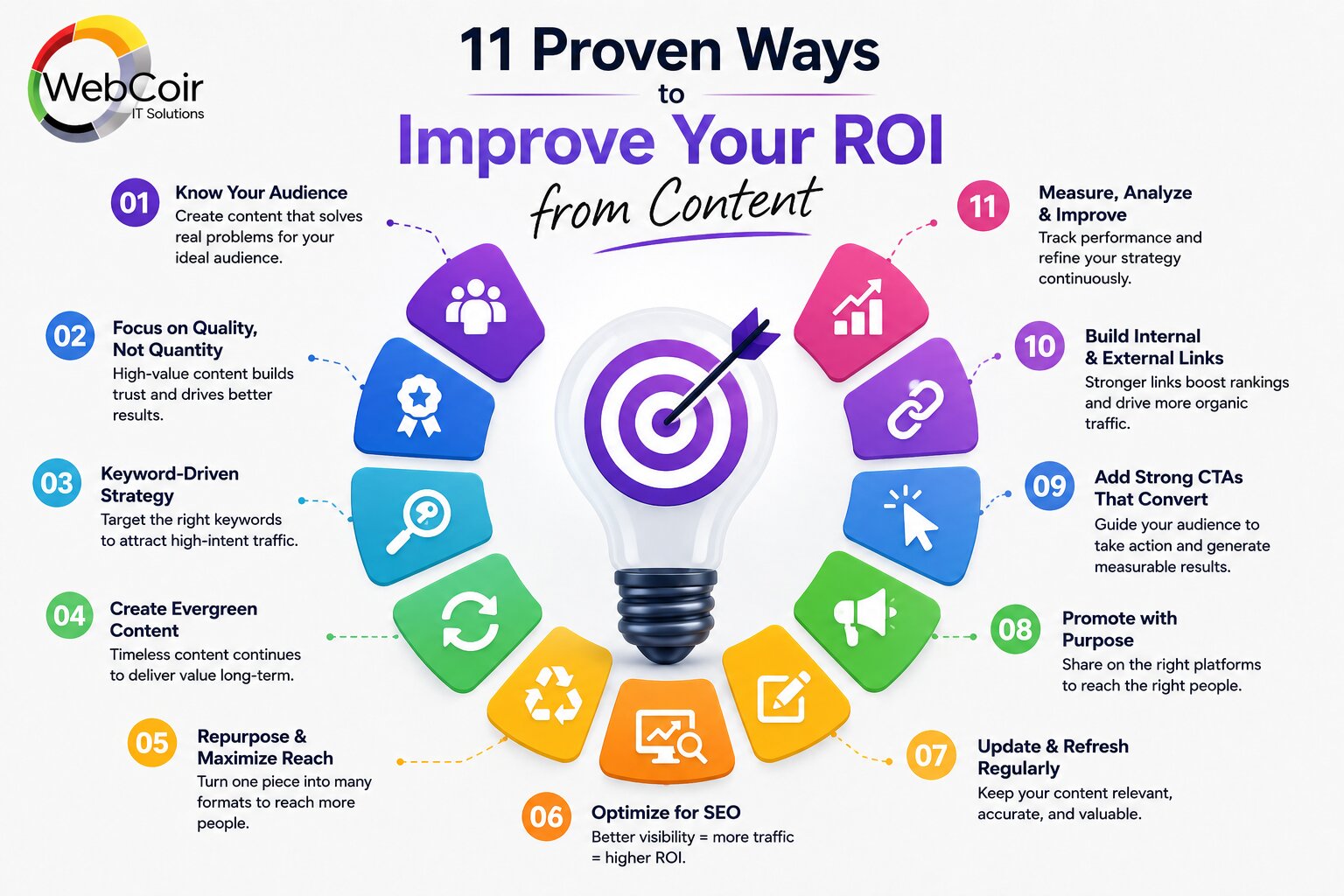
11 Proven Ways to Improve Your ROI from Content
Most businesses invest in content marketing but struggle to prove what it actually returns. Publishing more articles rarely solves the problem. What separates brands that grow from content and those that merely publish is intentionality — in strategy, execution, and measurement.
This guide covers 11 actionable ways to improve your ROI from content in 2026, whether you are optimising an existing content engine or building one from scratch.
1. Understand What Content ROI Actually Means
You cannot improve what you do not measure correctly. Content ROI is the measurable value generated from your content relative to the total cost of creating and distributing it. It includes leads, conversions, revenue attribution, and lifetime customer value — not just page views.
Key Metrics to Track
- Organic sessions and keyword ranking positions
- Leads and email sign-ups generated per content piece
- Content conversion rate optimization across landing and blog pages
- Revenue attributed to content-assisted conversions in GA4
2. Audit Before You Create
One of the fastest ways to improve content marketing performance is to evaluate what you already have. A structured content audit identifies which posts generate traffic and leads, which are stagnant, and which can be refreshed or consolidated for faster ranking gains.
Three-Step Audit Process
- Step 1: Export all URLs from Google Search Console.
- Step 2: Tag each piece as keep, update, merge, or remove.
- Step 3: Prioritise updates on pages ranked positions 5 to 20.
3. Map Every Piece to a Funnel Stage
Content without a funnel role rarely converts. Top-of-funnel pieces build awareness. Middle-of-funnel content nurtures intent. Bottom-of-funnel content drives decisions. When every piece has a defined stage, content conversion rate optimization becomes systematic rather than accidental.
Content by Stage
- TOFU: Blog posts, guides, infographics
- MOFU: Comparison articles, case studies, webinars
- BOFU: Testimonials, product pages, ROI calculators, free consultations
4. Optimise for Featured Snippets and AI Overviews
Google’s AI Overviews in 2026 pull concise answers directly from well-structured content. Formatting key sections with short definitions, numbered steps, and FAQ blocks increases your chance of appearing in these positions — improving organic traffic ROI without requiring additional content production.
Quick Optimisation Tactics
- Use H2 and H3 headings phrased as questions matching People Also Ask
- Answer the heading question within the first two sentences
- Add FAQ schema markup to every blog post
5. Repurpose High-Performing Content Across Formats
A single well-researched blog post can become a LinkedIn carousel, a YouTube script, an email newsletter, and a short-form Reel. Repurposing multiplies content marketing performance without multiplying production cost, which is the most direct way to improve ROI per piece created.
6. Strengthen CTAs to Convert Readers Into Leads
Traffic without conversion produces zero ROI. Every content piece needs a clear, contextually relevant call to action. CTAs that connect directly to the topic just consumed — a related checklist, a free audit, or a relevant service page — consistently outperform generic ones by a wide margin.
High-Converting CTA Types
- Downloadable resource related to the article topic
- Free audit or consultation relevant to the content
- Internal link to a high-intent service or product page
7. Build Topical Authority With Content Clusters
Google rewards depth of expertise. A content cluster — one comprehensive pillar page supported by multiple sub-topic articles — builds topical authority faster than isolated posts. Strong internal linking across the cluster also improves organic traffic ROI by distributing page authority across the site.
8. Plan Content With Data, Not Intuition
Creating content based on assumption is expensive. Data-driven planning reduces wasted output and improves content marketing performance by ensuring every piece targets a keyword with proven demand and commercial alignment. Use Search Console, Ahrefs or Semrush, and first-party CRM data to prioritise topics.
9. Improve Page Experience to Increase Dwell Time
Content quality alone does not determine ranking or ROI. Core Web Vitals, mobile responsiveness, load speed, and readability all affect how long users stay and whether they convert. A fast, well-formatted page earns significantly more from every visitor than slow, cluttered content.
Quick Page Experience Wins
- Compress images and enable lazy loading
- Use short paragraphs of two to three sentences
- Add a table of contents to all long-form posts
10. Track ROI With a Multi-Touch Attribution Model
Most businesses underestimate content’s revenue contribution because they rely on last-click attribution. A multi-touch model in GA4 reveals how content assists conversions throughout the full buyer journey, making the true organic traffic ROI visible and building the business case for continued investment.
11. Partner With a Content Marketing Expert to Scale Results
Implementing all of these strategies without a dedicated content team is difficult for most growing businesses. This is where the right partner changes everything.
Webcoir IT Solutions is a leading content marketing services provider in India, helping businesses build data-driven content strategies that deliver measurable ROI. From SEO-optimised blog content and topical cluster planning to full-funnel execution and performance reporting, Webcoir IT Solutions manages every layer of your content operation.
For Indian businesses ready to stop publishing for the sake of it and start generating real returns from content, Webcoir IT Solutions brings both the strategy and the execution to make it happen.
Frequently Asked Questions
What is a good ROI for content marketing?
Industry benchmarks show content marketing generates 3x more leads per dollar than outbound marketing. A good ROI depends on your cost per piece, conversion rate, and the revenue value of each lead. Multi-touch attribution in GA4 is the most reliable way to measure it accurately.
How long does it take to see ROI from content marketing?
Most businesses see measurable organic traffic and lead results within 3 to 6 months of consistent, SEO-focused content production. Repurposing and paid amplification of existing content can accelerate early results significantly.
What types of content deliver the highest ROI?
Long-form SEO blog posts of 1,500 words or more, comparison articles, and product-led case studies consistently deliver the highest ROI because they target high-intent keywords, rank for extended periods, and support multiple funnel stages simultaneously.
How do I measure content marketing ROI accurately?
Use Google Analytics 4 with goal tracking to measure content-attributed conversions. Assign a monetary value to each conversion goal and compare total content-attributed revenue against your total production and distribution cost. Review monthly and by content cluster for the clearest picture.