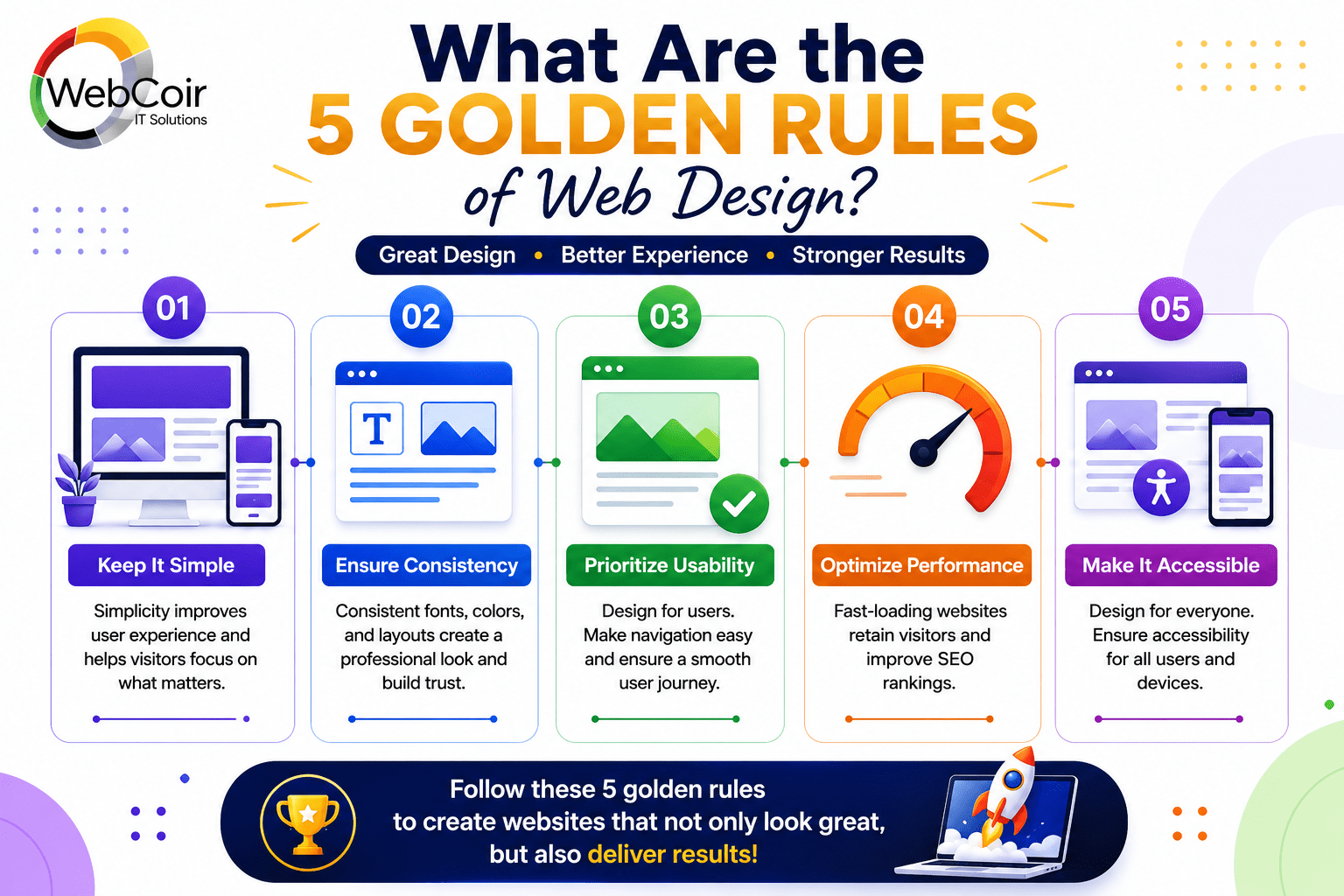
What Are the 5 Golden Rules of Web Design?
The 5 golden rules of web design are: Simplicity, Visual Hierarchy, Mobile-First Design, Fast Load Speed, and Clear Navigation. These principles ensure every website is user-friendly, accessible, and built to convert visitors into customers.
A well-designed website is not just about looks. It is about function, performance, and user experience. Whether you are building a new site or redesigning an existing one, these five golden rules of web design form the foundation of every high-performing website in 2026.
The 5 Golden Rules of Web Design Explained
Rule 1: Simplicity
Simple design is not lazy design — it is intentional design. A clutter-free layout helps users find what they need faster, reduces cognitive load, and keeps attention focused on the key action you want them to take. Remove every element that does not serve a purpose. White space is not empty space; it is breathing room that improves readability and guides the eye naturally.
Why it matters:
- Users decide whether to stay or leave within 3 seconds
- Simpler pages have higher conversion rates
- Less visual noise means more clarity on your core message
Rule 2: Visual Hierarchy
Visual hierarchy tells users where to look first, second, and third. Size, colour, contrast, and spacing all communicate importance. Your most critical element — a headline, a button, a value proposition — must be the first thing the eye lands on. Without hierarchy, every element competes equally and nothing wins.
How to apply it:
- Use larger text for headings, smaller for supporting content
- Apply your brand’s strongest colour to the primary CTA button only
- Group related elements together using proximity
Rule 3: Mobile-First Design
Over 65 percent of web traffic globally now comes from mobile devices. Google uses mobile-first indexing, meaning your mobile version is what determines your search ranking. Designing mobile-first forces you to prioritise what truly matters and then scale up for larger screens — not the other way around.
Mobile-first checklist:
- Tap targets are at least 44×44 pixels
- Text is readable without zooming at 16px minimum
- No horizontal scrolling on any screen size
Rule 4: Fast Load Speed
A one-second delay in page load time reduces conversions by up to 7 percent. Google’s Core Web Vitals directly tie page speed to search rankings. Speed is not a technical luxury — it is a core design requirement. Every image, font, and script you add to a page costs load time and potentially costs you a customer.
Speed essentials:
- Compress and serve images in WebP format
- Minimise CSS, JavaScript, and third-party scripts
- Pass all three Core Web Vitals: LCP, CLS, and INP
Rule 5: Clear Navigation
Navigation is the map of your website. If users cannot find what they are looking for within two clicks, they leave. A clear, consistent navigation structure reduces bounce rate, increases pages per session, and builds the kind of user confidence that leads to conversions. Keep menus simple, labels obvious, and the path to key pages short.
Navigation best practices:
- Limit top-level menu items to five to seven
- Use descriptive labels, not clever ones
- Always include a visible search function on content-heavy sites
Need a Website That Follows All 5 Rules?
Webcoir IT Solutions is a professional web design and digital marketing company in India. They build websites that are fast, mobile-optimised, visually structured, and designed to convert — following every golden rule from strategy to launch. If your current website is not performing, Webcoir IT Solutions offers a free website audit to show you exactly what needs to change.
Frequently Asked Questions
What is the most important rule of web design?
Simplicity is widely considered the most important rule of web design. A simple, uncluttered layout helps users navigate quickly, reduces bounce rate, and keeps focus on the desired action. All other design decisions — hierarchy, speed, navigation — are easier to execute well when simplicity is the starting point.
Why is mobile-first design a golden rule of web design?
Mobile-first design is a golden rule because over 65 percent of global web traffic comes from mobile devices and Google uses mobile-first indexing to determine search rankings. Designing for mobile first ensures the most constrained version of your site works perfectly, which naturally improves the desktop experience too.
How does page speed relate to web design?
Page speed is a direct result of design decisions. Every image, animation, font, and third-party script added to a page increases load time. Fast web design means making deliberate, performance-aware choices about every element included. Google’s Core Web Vitals measure this and factor it directly into search rankings.
What is visual hierarchy in web design?
Visual hierarchy in web design is the arrangement of elements so that users naturally see the most important content first. It is created using size, colour, contrast, spacing, and position. A strong visual hierarchy guides the eye from headline to value proposition to call to action without the user having to think about where to look.
How many items should a website navigation menu have?
A website navigation menu should ideally have five to seven top-level items. Research shows that users can comfortably hold this number of choices in working memory. More than seven options increases decision fatigue and makes the site feel complex, which raises bounce rate and reduces conversions.