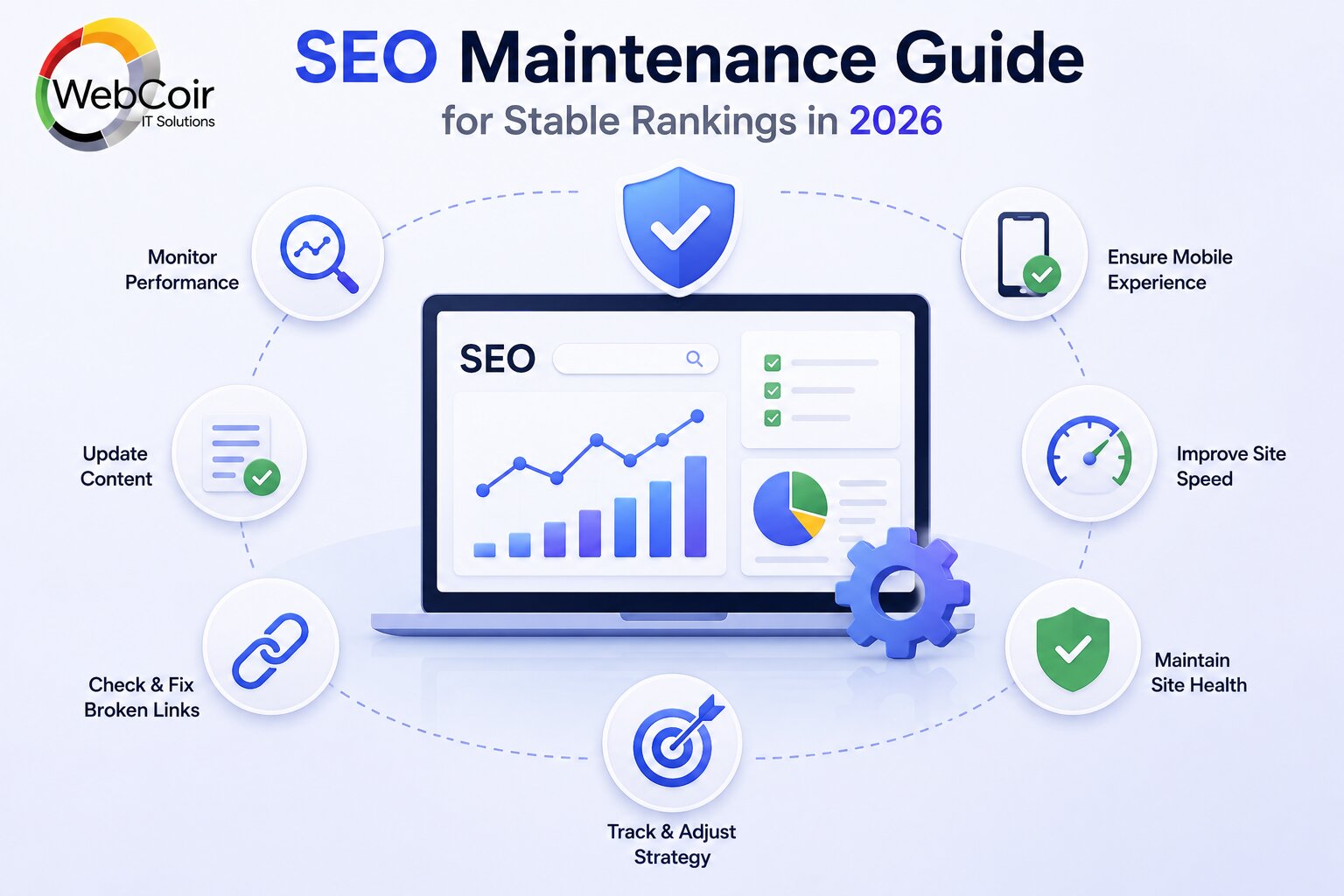
SEO Maintenance Guide for Stable Rankings in 2026
SEO isn’t just a one-time thing anymore. By 2026, sites that are continuously optimized will be visible on Google in the long run. Search engine algorithms have become smarter in recent years, user expectations have grown, and the way websites get traffic is being transformed by AI-generated search results. Businesses need to update and optimize their websites regularly for rankings and organic growth.
A lot of sites lose traffic. It’s not because they have bad content, it’s because they fail to maintain their SEO strategy. Slow loading websites, old content, bad mobile experience, technical issues will slowly push down rankings. Thus, SEO maintenance has become an integral part of digital marketing.
What is SEO Maintenance?
SEO maintenance is the ongoing process of monitoring, updating, and improving a website so it continues to perform well in search engines . It includes technical optimisation, content updating, keyword monitoring, backlink analysis and user experience improvements.
Search engine optimization is always changing. Google updates its algorithms on a regular basis to provide better search results for its users. Sites that don’t adapt tend to get hit with sudden ranking drops. Search Engine Optimization Maintenance is maintaining your website up to date with search engine requirements and compliant with modern SEO standards.
In simple words, SEO maintenance protects your website’s rankings while creating opportunities for future growth.
Why SEO Maintenance is Important for Stable Rankings
A website that ranks well today may not rank well after a few months if it is not properly maintained. Competitors constantly improve their content, build new backlinks, and optimize user experience. If your website remains unchanged, it can slowly lose authority and visibility.
One of the biggest reasons SEO maintenance is important is because search intent changes over time. Users may search differently in 2026 compared to previous years. Updating your content according to current trends helps your pages remain relevant and valuable.
SEO maintenance also helps identify technical problems before they become serious. Issues such as broken links, duplicate content, indexing errors, or slow page speed can negatively affect rankings. Regular audits help solve these problems quickly.
Another important reason is Google AI Overviews. Google increasingly prefers websites that provide structured, updated, and trustworthy information. Websites with regularly refreshed content and strong technical SEO have better chances of appearing in AI-generated search summaries.
Key Components of an SEO Maintenance Strategy
Technical SEO Monitoring
Technical SEO forms the foundation of a successful website. Even the best content may struggle to rank if search engines cannot properly crawl and index your pages.
Regular technical audits help ensure that:
- All important pages are indexed correctly
- There are no crawl errors
- Broken links are fixed
- Website speed remains optimized
- Mobile usability issues are resolved
Core Web Vitals are also extremely important in 2026. Google measures user experience through loading speed, visual stability, and interaction responsiveness. Websites that provide a smooth browsing experience are more likely to maintain stable rankings.
Content Updates and Optimization
Content freshness plays a major role in SEO success. Google prefers updated content that reflects the latest information and user intent.
Instead of publishing only new blogs, businesses should also improve older content by:
- Updating outdated statistics
- Adding new sections
- Improving readability
- Optimizing keywords naturally
- Including FAQs and structured headings
Content optimization also improves engagement. Users spend more time on pages that are easy to read and provide clear answers. This positive engagement sends strong quality signals to Google.
In 2026, content should also be optimized for AI search results. AI-generated summaries often prefer content that directly answers user questions in a structured and simple format.
Keyword Performance Tracking
Keyword rankings change constantly due to algorithm updates and competitor activity. Monitoring keyword performance helps identify opportunities and problems early.
Businesses should regularly analyze:
- Ranking positions
- Organic traffic
- Click-through rates
- Impressions
- Conversion rates
If rankings decline, content improvements, internal linking, and updated metadata can often help recover visibility.
SEO maintenance is not only about gaining rankings but also about maintaining consistent traffic and conversions over time.
Backlink Profile Management
Backlinks remain one of the strongest ranking factors in SEO. However, quality is now more important than quantity.
A healthy backlink profile helps improve domain authority and search visibility. During SEO maintenance, websites should monitor:
- Toxic backlinks
- Lost backlinks
- Competitor link strategies
- New linking opportunities
Building backlinks from trusted and relevant websites strengthens credibility and helps maintain stable rankings even during major Google updates.
Internal Linking Optimization
Internal linking helps search engines understand website structure and relationships between pages. It also improves user navigation and distributes authority across the site.
Strong internal linking strategies include:
- Connecting related blog posts
- Using descriptive anchor text
- Creating topic clusters
- Updating links to important pages
Internal linking is especially useful for improving content discoverability and increasing time spent on the website.
How Often Should SEO Maintenance Be Performed?
SEO maintenance should be an ongoing process rather than a yearly activity.
Weekly monitoring helps identify sudden ranking or traffic changes. Monthly audits are useful for fixing technical issues and updating content. Quarterly reviews help evaluate overall SEO performance and competitor strategies.
Businesses that perform regular SEO maintenance usually recover faster from algorithm updates and maintain stronger long-term visibility.
Common SEO Maintenance Mistakes
One common mistake is ignoring older content. Many businesses focus only on publishing new blogs while outdated pages slowly lose rankings.
Another mistake is failing to monitor technical errors. Small issues such as broken pages or indexing problems can significantly affect organic visibility over time.
Keyword stuffing is also a major issue. Modern SEO focuses more on user intent, content quality, and experience rather than excessive keyword usage.
Lastly, many websites ignore mobile optimization and page speed improvements. Since most searches now happen on mobile devices, poor mobile experience can directly impact rankings and conversions.
Conclusion
By 2026, maintaining SEO is important for long-term success online. Search engine rankings are always changing, and sites that are proactive in managing their SEO performance are more prone to stable visibility and steady traffic growth.
The SEO maintenance strategy can encompass technical optimization, content updates, keyword tracking, backlink management, and user experience enhancements. These efforts will not only protect rankings but will also improve website authority and engagement.
As Google continues to evolve with AI-powered search experiences, businesses that focus on ongoing SEO maintenance will have a huge advantage over competitors that only rely on old SEO practices.