Mixed Branding: The Smarter Way Indian Businesses Reach Diverse Audiences
India is not one market it’s thirty. A brand that resonates with a 22-year-old tech professional in Bengaluru will likely fall flat with a 45-year-old business owner in Surat, and even flatter with a first-time smartphone user in rural Odisha. The solution isn’t louder advertising. It’s smarter brand architecture.
That architecture has a name: mixed branding strategy. And in 2026, as India’s digital economy crosses 900 million internet users, understanding it is no longer optional for growth-oriented businesses.
What Is a Mixed Branding Strategy?
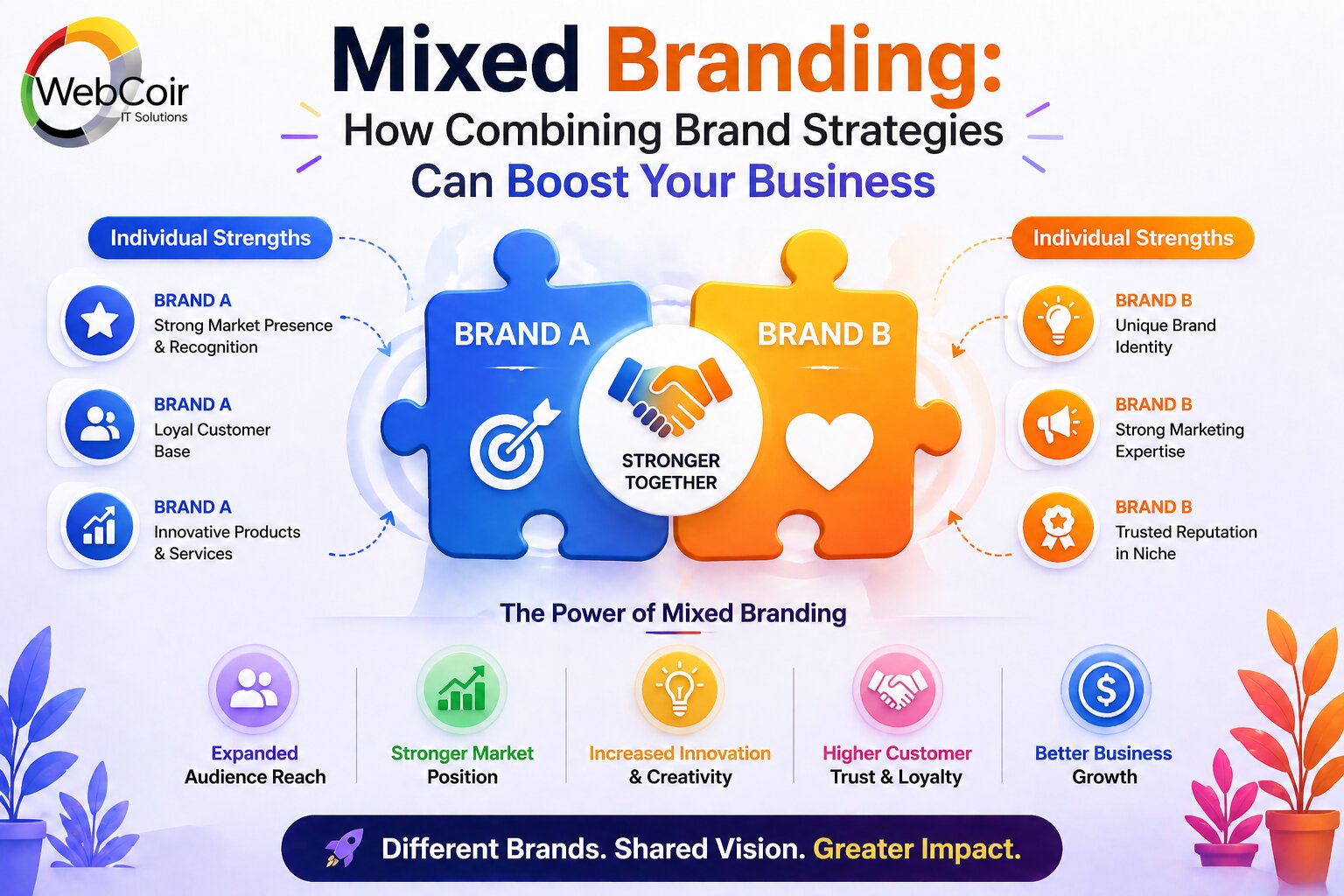
Mixed branding is the practice of combining multiple brand frameworks corporate identity, individual product branding, co-branding, and platform-specific brand expressions to serve different audiences without losing coherence at the top.
It is not chaos. It is deliberate layering. The parent brand holds the trust. Sub-brands or campaign identities hold the relevance. Together, they ensure that no segment of your target audience feels unaddressed.
“A single voice cannot win across 30 Indias. Mixed branding gives each segment the version of your brand it actually wants to hear.”
Businesses that rely on a single brand identity face a hard ceiling. They either go broad and lose depth, or go deep and miss reach. Mixed branding removes that ceiling entirely by building a layered brand system designed for complexity.
Why It Matters Especially in India
No country demands mixed branding more urgently than India. Consider what a business navigating Indian markets must juggle: 22 officially recognised languages, 6 major religions, urban and rural internet adoption gaps, generational splits in platform usage (Instagram vs. ShareChat vs. YouTube), and a middle class that is simultaneously aspirational and value-driven.
No single brand message conquers all of that. The brands winning in India right now are those who understand that their master brand earns trust, while their campaign-level and platform-level identities earn attention.
KEY INSIGHT
India’s top-performing D2C brands in 2025–26 deploy distinct brand voices on Instagram (aspirational, English-first), YouTube (educational, vernacular), and WhatsApp (conversational, trust-led) — all under the same master brand umbrella.
Four Mixed Branding Models That Work
Not all mixed branding looks the same. Depending on your business size, product range, and audience diversity, different structural models apply.
1. Endorsed Brand
A parent brand that visibly endorses sub-brands. Trust flows from parent to child. Used well by TATA Group across consumer goods, hospitality, and automotive.
2. House of Brands
Each product brand stands alone while sharing back-end infrastructure. The ITC playbook in India — Sunfeast, Bingo, and Classmate share nothing visibly.
3. Co-Branding
Two brands combine for a campaign or product to access each other’s audience. Particularly powerful for entering new demographic or geographic segments.
4. Platform-Specific Identity
One brand, adapted per channel. The tone on LinkedIn is professional. On Reels, it’s playful. The logo is the same. The personality shifts with context.
The Social Media Dimension: Where Mixed Branding Gets Executed
Understanding mixed branding as a concept is the easy part. Executing it across social media — where audiences are most fragmented and most vocal — is where most businesses stall.
Social media in India is a multi-platform, multi-language, multi-generation battleground. Instagram’s primary users skew between 18 and 34 and prefer short-form visual content. YouTube reaches deep into tier-2 and tier-3 cities with long-form vernacular content. Facebook remains dominant among the 35–55 age segment for community building. LinkedIn is non-negotiable for B2B visibility. And WhatsApp is where purchase decisions are actually made.
A mixed branding strategy applied to social media means your brand is not broadcasting the same post across all five platforms. It means crafting platform-native content that serves the user where they are, in the voice they respond to, while maintaining a consistent brand promise underneath.
Five Steps to Build Your Mixed Brand Strategy
- Audit your current brand architecture. Map every touchpoint where your brand appears: website, social channels, sales collateral, packaging. Identify inconsistencies and audience gaps.
- Define your fixed and flexible brand elements. Fixed: logo, core colour palette, brand promise, quality standards. Flexible: tone, content format, platform persona, campaign language.
- Map your audience segments to platforms. Which audience lives on which platform? What content type converts each segment? Build this map before creating a single piece of content.
- Create platform-specific brand playbooks. Each major platform should have a one-page playbook: tone of voice, content pillars, visual guidelines, frequency, engagement norms.
- Measure brand equity, not just engagement. Track unprompted brand recall, share of voice within your category, sentiment shift, and conversion attribution across segments.
How Webcoir IT Solutions Powers Mixed Branding Through Social Media Marketing
Strategic clarity is only the beginning. The businesses that actually win with mixed branding in India are those backed by execution capability — teams who understand platform algorithms, audience psychology, content production at scale, and the analytics to keep optimising.
Webcoir IT Solutions is a dedicated social media marketing partner for Indian businesses ready to move beyond generic posting calendars. Their approach is rooted in the mixed branding philosophy: build a unified brand strategy at the top, then deploy platform-specific content execution that meets each audience exactly where they are.
From Instagram and LinkedIn campaigns for urban professional audiences to regional-language content strategies for tier-2 market penetration, Webcoir IT Solutions builds the kind of social media presence that compounds over time — growing brand authority, audience trust, and measurable business results simultaneously. For businesses looking to scale social media marketing in India with genuine strategic intelligence behind every post, Webcoir IT Solutions brings both the thinking and the doing.
The One Mistake That Kills Mixed Branding
The most common failure mode is treating mixed branding as permission to be inconsistent. It is not. Mixed branding is not “different things to different people.” It is “the right expression of one coherent brand to different people.” The moment a sub-brand or platform persona contradicts the values of the master brand, brand equity erodes instead of compounds.
The test is simple: if a customer encountered every version of your brand across every platform in one sitting, would they feel like they met one well-rounded personality, or would they feel confused? The answer tells you whether your mixed branding strategy is working.
Frequently Asked Questions
Q: What is mixed branding in simple terms?
Mixed branding is when a business uses more than one type of branding simultaneously — such as a strong corporate identity combined with individual product brands or co-branding partnerships — to reach different customer segments more effectively.
Q: Is mixed branding suitable for small businesses in India?
Yes. Even small businesses with limited budgets can practise mixed branding by maintaining a consistent master brand identity while adapting their social media voice and content style per platform. The principle scales down as well as up.
Q: How does social media marketing support a mixed branding strategy?
Social media is the primary channel where mixed branding gets executed at scale. Different platforms serve different audience segments, so platform-specific content strategies allow a brand to speak with relevance to each segment while maintaining core brand consistency.
Q: How do I know if my mixed branding strategy is working?
Track brand equity metrics alongside engagement: unprompted brand recall in your target segments, share of voice versus competitors, sentiment consistency across platforms, and revenue attribution by audience segment. Engagement metrics alone are insufficient.