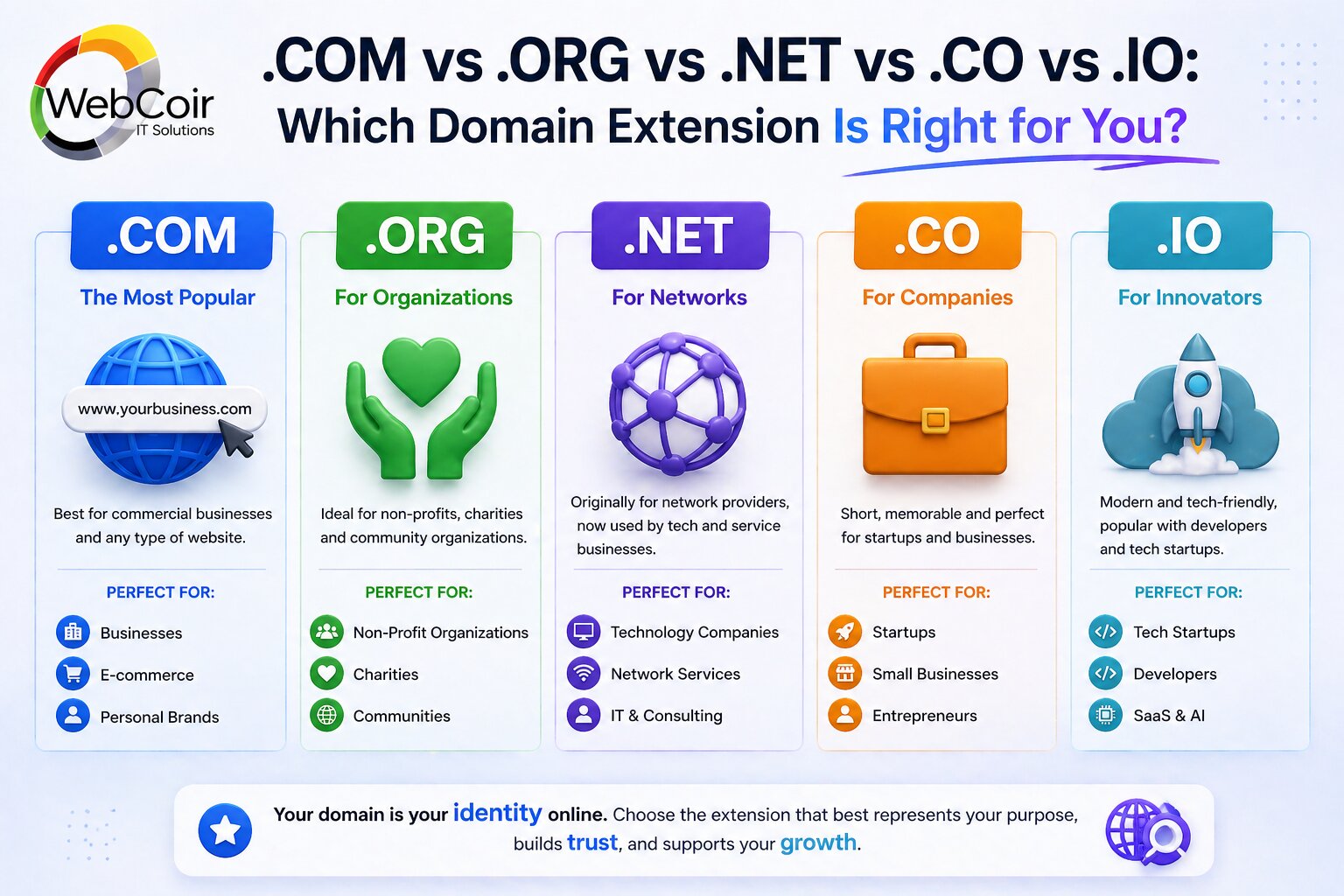
.COM vs .ORG vs .NET vs .CO vs .IO: Which Domain Extension Is Right for You?
One of the first things you’ll have to do when you sign up for a new website is pick the correct domain extension, which is also known as a Top-Level Domain (TLD). Your choice of TLD can change how people see your brand, how much they trust you, and even how high you rank in search engines. Choosing the right.com,.org,.net,.co, or.io domain name is more important than ever due to the large number of options. This tutorial makes it easy to understand each extension so you can make a smart choice.
What Are Domain Extensions and Why Do They Matter?
The section of a web address that comes after the last dot is called the domain extension. At first, each extension had a specialised use: .com for corporations, .org for groups, and .net for network services. These lines have become less clear over time, but how users see them has not changed substantially.
There are three basic reasons why domain extensions are important. First, they affect how people see your brand before they ever click. Second, Google has said that all generic TLDs are considered the same in ranking algorithms. This means that .com does not have any built-in SEO benefits. However, .com domains routinely get more clicks because people are more familiar with them, which can indirectly help their ranks. Third, website with a.io extension shows that it is a tech startup, while a.org extension gives charities instant credibility.
Breaking Down the Big Five: .COM, .ORG, .NET, .CO, and .IO
.COM — The Universal Standard
Around the world, more than half of all registered websites end in.com, making it the most well-known and trusted domain name. It’s great for businesses, online retailers, blogs, and any brand that wants to reach a lot of people. When people try to remember a website, they virtually invariably type in .com. The bad news is that most short, appealing .com names are already taken, which means they are generally pricey when sold again.
.ORG — Trust for Non-Commercial Entities
Originally reserved for non-profit organizations, .org has become synonymous with credibility and social mission. Wikipedia, Mozilla, and countless charities use .org to signal transparency and community service. While anyone can register a .org today, using it for a commercial business risks confusing visitors who expect a non-profit. It remains the gold standard for NGOs, foundations, open-source projects, and educational platforms.
.NET — The Network Alternative
The .net extension was originally intended for internet service providers and networking companies. Today it is commonly used as a fallback when the .com version of a name is unavailable. Technology companies, hosting platforms, and software providers frequently use .net. It carries reasonable credibility but is less memorable than .com, which can affect brand recall and direct traffic.
.CO — The Modern Global Alternative
Originally the country code for Colombia, .co has been repositioned as a global TLD representing companies and commerce. It has been embraced by startups and entrepreneurs who find their preferred .com name unavailable. Brands like Twitter’s URL shortener (t.co) helped legitimize .co for business use. The primary risk is user error — visitors familiar with .com may accidentally drop the final letter and land on the wrong site.
.IO — The Tech Startup Favorite
The .io extension — originally the country code for the British Indian Ocean Territory — has been wholeheartedly adopted by the tech and SaaS community. In programming, I/O stands for input/output, making it instantly recognizable to developers. Startups, developer tools, and gaming platforms regularly choose .io for its modern, technical appeal. It tends to have more availability than .com and carries strong credibility in tech circles, though it may seem less conventional to non-technical audiences.
Domain Extensions and SEO: What Google Actually Says
Google has said in public that search ranking algorithms consider generic TLDs like .com, .org, .net, .co, and .io the same way. There is no secret SEO benefit built into any one addon. The quality of your content, the authority of your backlinks, the speed of your site, and the overall experience of your users are what really affect SEO. The domain extension itself doesn’t affect any of these things.
That being said, your choice of TLD does have an indirect effect on SEO. Because people trust them more, .com domains tend to get more clicks in search results. A higher CTR tells Google that your site is relevant and can help it move up in the results over time. Google targets country-code TLDs like .in or .uk based on where they are located. This is good for local SEO but may limit your reach around the world. Choose an extension that fits your brand and your audience, and then get good SEO rankings by writing amazing content and getting links from trusted sources.
How to Choose the Right Domain Extension for Your Website
Choosing a domain extension is a strategic decision that should reflect your business type, target audience, and long-term goals. Here is a practical framework to guide your choice:
Use .com if:
You are building a business, e-commerce store, or personal brand targeting a broad audience. Always try to secure the .com version of your name if it is available and affordable. Brand recognition and user trust are highest with this extension.
Use .org if:
You run a non-profit, charity, educational platform, or open-source project where credibility and public trust are paramount. Visitors instinctively associate .org with transparent, mission-driven organizations.
Use .net if:
Your brand operates in networking, hosting, or internet services and the .com version of your name is already taken. It is a reasonable second choice that still carries professional credibility.
Use .co if:
You are a startup or entrepreneur who needs a short, memorable domain and your preferred .com name is unavailable. It works especially well for internationally focused brands.
Use .io if:
Your primary audience is developers, SaaS users, or the tech community. The .io extension signals modernity and innovation, giving your brand immediate credibility within technical circles.
Final Takeaway
Not everyone can use the same domain extension. The greatest TLD is one that fits your brand, connects with your audience, and is easy for people to remember. If .com is available and you can afford it, buy it. If not, .io and .co are good modern choices for new businesses, while .org is still the best choice for organisations with a goal. No matter what you choose, make sure you have good content, a fast user experience, and strong backlinks. Google will always care more about those things than the letters following your dot.