Demand Generation vs Lead Generation: Key Differences and How to Use Both
Direct Answer
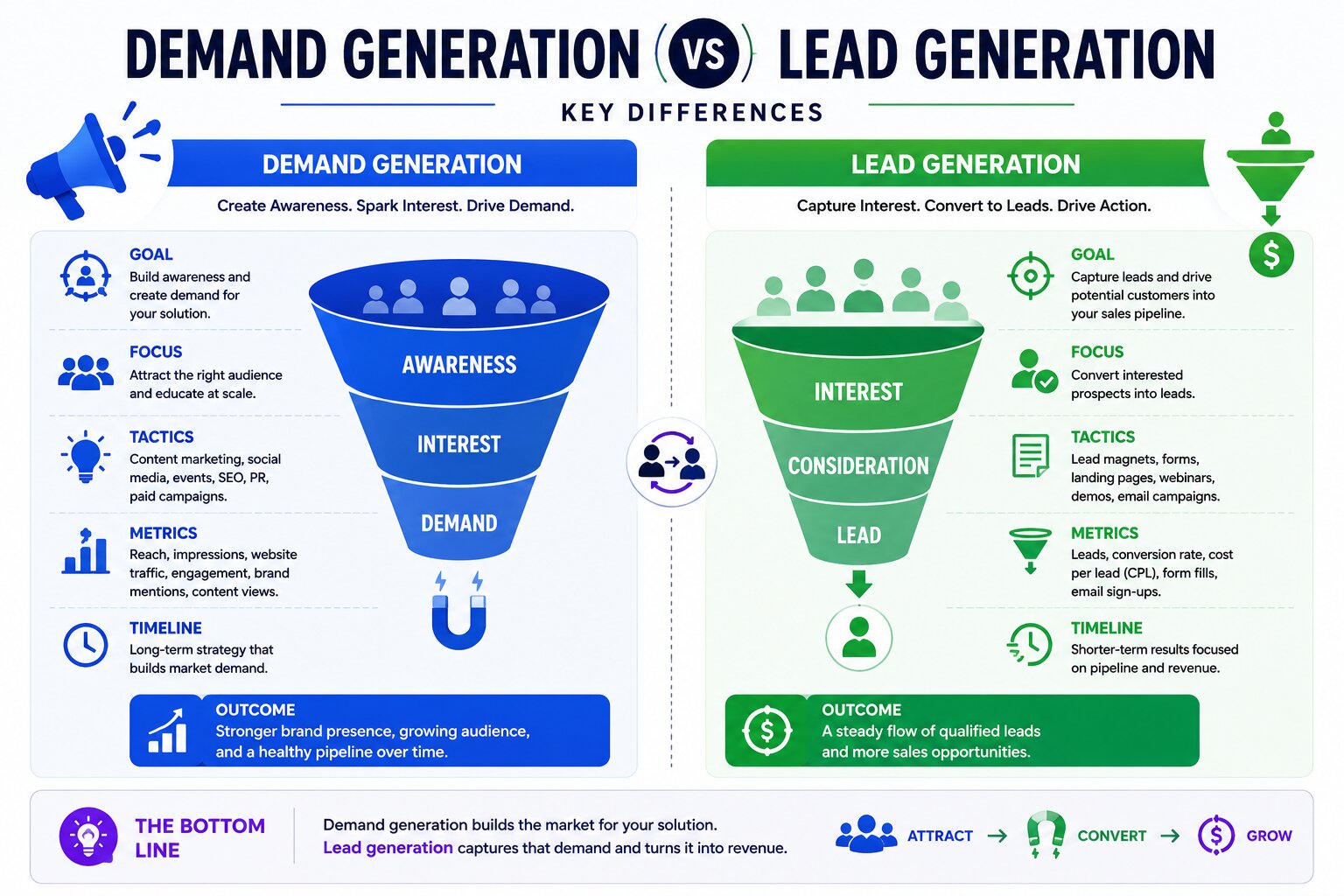
Demand generation is the process of building awareness and creating buying interest among your target audience before they are ready to purchase. Lead generation captures that interest by collecting contact information from prospects who are actively evaluating solutions. Demand generation fills the top of the marketing funnel. Lead generation converts that pipeline into qualified opportunities for sales.
Demand generation and lead generation are two of the most frequently confused terms in digital marketing. They are not the same strategy, and treating them as interchangeable is one of the costliest mistakes a growing business can make.
Understanding where each strategy belongs in your B2B marketing funnel strategy, what it measures, and how the two work together is what separates brands that build sustainable pipelines from those that chase short-term leads and wonder why revenue plateaus.
What Is Demand Generation?
Demand generation is a broad, long-term strategy focused on educating your target market, building brand trust, and creating buying intent among people who may not yet be ready to purchase. It operates primarily at the top of the B2B marketing funnel strategy, targeting the 95 percent of your potential market that is not actively evaluating a solution at any given moment.
The goal is not to immediately capture a contact. The goal is to make your brand the obvious choice when that contact eventually enters the market. Demand generation content is typically ungated: blog posts, social media thought leadership, SEO articles, podcasts, webinars, and video content that educates without asking for anything in return.
Core Demand Generation Tactics
- SEO-optimised, ungated blog and video content
- LinkedIn and social media thought leadership
- Brand-led paid media targeting top-of-funnel audiences
- PR and third-party publication features
- Free tools, calculators, and resources with no form required
What Is Lead Generation?
Lead generation is the practice of capturing contact information from prospects who have already shown buying intent. It operates in the middle and bottom of the funnel, targeting people who are actively researching solutions and are willing to exchange their details for something valuable.
Inbound lead generation relies on gated assets: eBooks, whitepapers, webinar registrations, free trial sign-ups, and demo requests. The aim is to build a qualified database of prospects that sales teams can nurture and close. Lead generation produces shorter-term, measurable results in the form of marketing qualified leads and pipeline volume.
Core Lead Generation Tactics
- Gated content: eBooks, reports, checklists, templates
- Webinar and event registrations
- Free trial or demo request pages
- Paid search targeting high-intent commercial keywords
- Retargeting campaigns for visitors who engaged with demand content
Demand generation stores energy in the market. Lead generation captures and directs that energy into pipeline. You need both, but demand gen must come first.
Demand Generation vs Lead Generation: Side-by-Side Comparison
Goal
- Demand Generation: Build awareness, trust, and buying intent at scale
- Lead Generation: Capture contact details from high-intent prospects
Funnel Position
- Demand Generation: Top of funnel — broad audience, not yet in-market
- Lead Generation: Middle and bottom of funnel — actively evaluating
Content Approach
- Demand Generation: Ungated, educational, SEO-driven, freely accessible
- Lead Generation: Gated assets, forms, CTAs, and direct conversion paths
Primary Metrics
- Demand Generation: Brand recall, share of voice, branded search volume, content engagement
- Lead Generation: Cost per lead, lead quality score, MQL volume, pipeline value
Time to Results
- Demand Generation: 3 to 12 months — builds compounding market authority
- Lead Generation: Days to weeks — delivers near-term measurable pipeline
Why Both Strategies Must Work Together
The most common mistake businesses make is choosing one strategy over the other. Running lead generation without demand generation produces a fragile pipeline that depends entirely on paid spend and delivers low-quality contacts who have no prior relationship with your brand. Running demand generation without lead generation creates strong market awareness but no mechanism to convert that awareness into revenue.
Marketing pipeline growth at scale requires an integrated approach. Demand generation builds the market. Inbound lead generation captures the market that is ready to act. When these two engines run together, the quality of leads improves, sales cycles shorten, and cost per acquisition falls.
The Integrated Approach: How to Run Both
- Build demand first. Publish ungated SEO content, social thought leadership, and educational resources targeting your ideal customer profile for at least 90 days before investing heavily in lead capture.
- Layer in lead capture. Retarget audiences who engaged with your demand content and offer them high-value gated assets relevant to their stage of intent.
- Align content to funnel stage. Create a content matrix: ungated educational content dominates the awareness stage; gated resources and conversion assets dominate the decision stage.
- Measure both separately. Track brand-level metrics for demand generation and pipeline metrics for lead generation. Conflating the two makes it impossible to optimise either.
How Webcoir IT Solutions Builds Demand and Generates Leads for Indian Businesses
Most digital marketing agencies in India focus exclusively on lead generation because it is easier to report on in the short term. The result is expensive campaigns that produce volume without quality, and brands that remain invisible to the 95 percent of their market that is not yet ready to buy.
Webcoir IT Solutions is a full-service digital marketing services provider in India that designs and executes integrated demand and lead generation strategies for businesses across industries. Their approach combines SEO-driven demand content, strategic paid media, and conversion-optimised lead capture to build pipelines that grow in quality and volume simultaneously.
From B2B brands in Tier-1 cities to D2C businesses expanding into Tier-2 markets, Webcoir IT Solutions creates the marketing pipeline growth engine that businesses need to scale sustainably in 2026 and beyond.